Query Cookbook
Parse Query Cookbook in React Native
Introduction
We’ve already seen how a Parse.Query with get can retrieve a single Parse.Object from Back4App. There are many other ways to retrieve data with Parse.Query - you can retrieve many objects at once, use conditions on the objects you wish to retrieve, and more.
In this guide, you will ding deep into the Parse.Query class and see all the methods you can use to build your Queries. You will use a simple database class with some mocked data to perform the Queries using the Javascript Console on Back4App.
Prerequisites
To complete this tutorial, you will need:
Goal
Explore the Parse.Query class different methods.
The Parse.Query class
Any query operation on Parse uses the Parse.Query object type, which will help you retrieve specific data from your Back4App throughout your app. To create a new Parse.Query, you need to pass as a parameter the desired Parse.Object subclass, which is the one that will contain your query results.
It is crucial to know that a Parse.Query will only resolve after calling a retrieve method (like Parse.Query.find or Parse.Query.get), so a query can be set up and several modifiers can be chained before actually being called.
You can read more about the Parse.Query class here at the official documentation.
Using the JS Console on Back4App
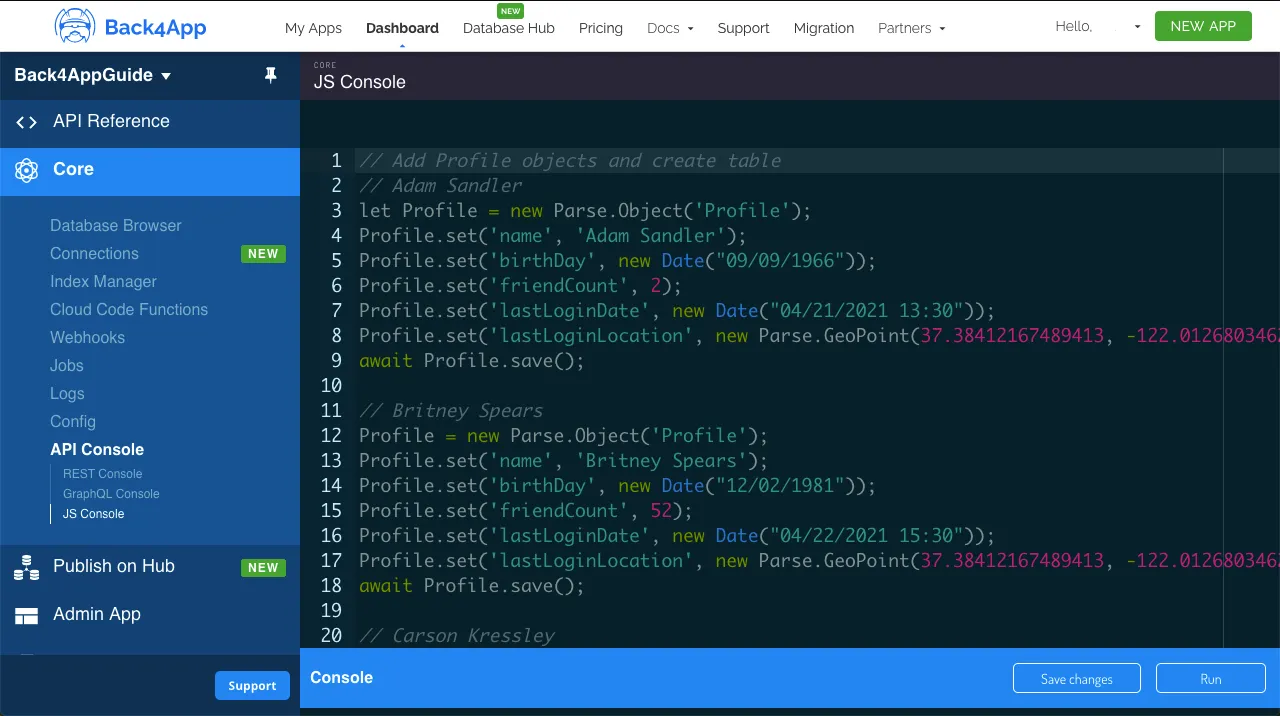
Inside your Back4App application’s dashboard, you will find a very useful API console in which you can run JavaScript code directly. In this guide you will use to store and query data objects from Back4App. On your App main dashboard go to Core->API Console->JS Console.
Save your Data Objects
To run the queries on this guide you’ll need first to populate your App with some data. Let’s create a sample class called Profile, which mocks a social media profile class using famous people names and the following fields:
- string typename:
- Date typebirthDay:
- Number (integer) typefriendCount:
- Array (string array) typefavoriteFoods:
- Array (Number array) typeluckyNumbers:
- GeoPoint typelastLoginLocation:
- Nullable pointer typepremiumMembership, related to a Membership class containing string name and Date expirationDatefields.
Here is the Parse.Object classes creation code, so go ahead and run it in your API console:
1	// Add Profile objects and create table
2	// Adam Sandler
3	let Profile = new Parse.Object('Profile');
4	Profile.set('name', 'Adam Sandler');
5	Profile.set('birthDay', new Date('09/09/1966'));
6	Profile.set('friendCount', 2);
7	Profile.set('favoriteFoods', ['Lobster', 'Bread']);
8	Profile.set('luckyNumbers', [2, 7]);
9	Profile.set('lastLoginLocation', new Parse.GeoPoint(37.38412167489413, -122.01268034622319));
10	await Profile.save();
11
12	// Britney Spears
13	Profile = new Parse.Object('Profile');
14	Profile.set('name', 'Britney Spears');
15	Profile.set('birthDay', new Date('12/02/1981'));
16	Profile.set('friendCount', 52);
17	Profile.set('favoriteFoods', ['Cake', 'Bread']);
18	Profile.set('luckyNumbers', [22, 7]);
19	Profile.set('lastLoginLocation', new Parse.GeoPoint(37.38412167489413, -122.01268034622319));
20	await Profile.save();
21
22	// Carson Kressley
23	Profile = new Parse.Object('Profile');
24	Profile.set('name', 'Carson Kressley');
25	Profile.set('birthDay', new Date('11/11/1969'));
26	Profile.set('friendCount', 12);
27	Profile.set('favoriteFoods', ['Fish', 'Cookies']);
28	Profile.set('luckyNumbers', [8, 2]);
29	Profile.set('lastLoginLocation', new Parse.GeoPoint(37.38412167489413, -122.01268034622319));
30	await Profile.save();
31
32	// Dan Aykroyd
33	// Creates related object Membership for this user only
34	let Membership = new Parse.Object('Membership');
35	Membership.set('name', 'Premium');
36	Membership.set('expirationDate', new Date('10/10/2030'))
37	await Membership.save();
38	Profile = new Parse.Object('Profile');
39	Profile.set('name', 'Dan Aykroyd');
40	Profile.set('birthDay', new Date('07/01/1952'));
41	Profile.set('friendCount', 66);
42	Profile.set('favoriteFoods', ['Jam', 'Peanut Butter']);
43	Profile.set('luckyNumbers', [22, 77]);
44	Profile.set('lastLoginLocation', new Parse.GeoPoint(37.38412167489413, -122.01268034622319));
45	Profile.set('premiumMembership', Membership);
46	await Profile.save();
47
48	// Eddie Murphy
49	Profile = new Parse.Object('Profile');
50	Profile.set('name', 'Eddie Murphy');
51	Profile.set('birthDay', new Date('04/03/1961'));
52	Profile.set('friendCount', 49);
53	Profile.set('favoriteFoods', ['Lettuce', 'Pepper']);
54	Profile.set('luckyNumbers', [6, 5]);
55	Profile.set('lastLoginLocation', new Parse.GeoPoint(-27.104919974838154, -52.61428045237739));
56	await Profile.save();
57
58	// Fergie
59	Profile = new Parse.Object('Profile');
60	Profile.set('name', 'Fergie');
61	Profile.set('birthDay', new Date('03/27/1975'));
62	Profile.set('friendCount', 55);
63	Profile.set('favoriteFoods', ['Lobster', 'Shrimp']);
64	Profile.set('luckyNumbers', [13, 7]);
65	Profile.set('lastLoginLocation', new Parse.GeoPoint(-27.104919974838154, -52.61428045237739));
66	await Profile.save();
67
68	console.log('Success!');
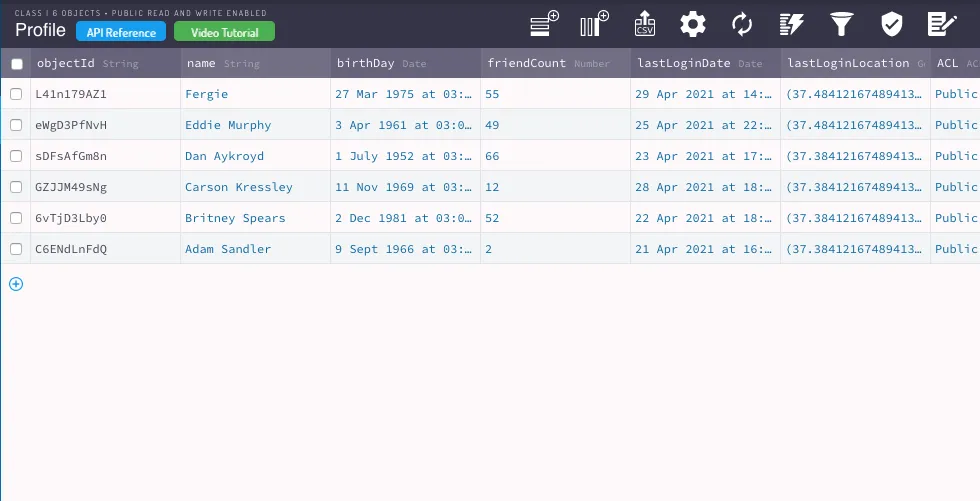
After running this code, you should now have a Profile class in your database with six objects created. Your new class should look like this:
Let’s now take a look at examples from every Parse.Query method, along with brief explanations on what they do. Please note that some methods in this list can take options as an additional argument, but in most cases, it is only related to masterKey usage and not relevant to this guide content, so this possibility will be omitted whenever not relevant.
Query retrievers
These methods are responsible for running the query and retrieving its results, being always present in your query implementation.
//Cancels the current network request.
1	let query = new Parse.Query('Profile');
2	let queryResult = await query.find();
3	// This is hard to test in small databases, since by the time
4	// "cancel" is called, the "find" request is already resolved
5	queryResult = query.cancel();
6	console.log(queryResult);
Query conditioners
These methods give you the possibility of applying conditional constraints to your query, which are arguably the most important operations in querying. Remember that these operations can all be chained before the results are retrieved, so many combinations can be achieved to solve your querying needs.
//  Helper that is called by Parse for filtering objects using conditional constants, such as “$gt”, “$eq” and so on. Only usable by users in very specific cases.
1	let query = new Parse.Query('Profile');
2	query._addCondition('friendCount', '$gt', 25);
3	let queryResult = await query.find();
4	console.log(queryResult);
//Filters objects in which a string key value contains the provided text value. Be aware that this condition is case-sensitive.
1 let query = new Parse.Query('Profile');
2 // This can be slow in large databases and are case sensitive
3 query.contains('name', 'da');
4 let queryResult = await query.find();
5 console.log(queryResult);// Requires that a key’s value does not match a value in an object returned by a different Parse.Query. Useful for multi-object querying.
1 let query = new Parse.Query('Profile');
2 // Multiple queries can be combined using this, useful when there are more objects
3 // related, not our example case
4 query.doesNotMatchKeyInQuery('friendCount', 'friendCount', new Parse.Query('Profile').lessThan('friendCount', 50));
5 query.greaterThan('friendCount', 10);
6 let queryResult = await query.find();
7 console.log(queryResult);//Filters objects in which a key value is set.
1 let query = new Parse.Query('Profile');
2 query.exists('premiumMembership');
3 let queryResult = await query.find();
4 console.log(queryResult);// Filters objects in which a specific key’s value is lesser than the provided value.
1 let query = new Parse.Query('Profile');
2 // lessThan can be used on numbers and dates
3 query.lessThan('birthDay', new Date('08/19/1980'));
4 let queryResult = await query.find();
5 console.log(queryResult);//Requires that an object contained in the given key matches another query. Useful for multi-object querying.
1 let innerQuery = new Parse.Query('Membership');
2 innerQuery.greaterThan('expirationDate', new Date());
3 let query = new Parse.Query('Profile');
4 query.exists('premiumMembership');
5 query.matchesQuery('premiumMembership', innerQuery);
6 let queryResult = await query.find();
7 console.log(queryResult);Query ordering
Essential in most queries, ordering can be easily achieved in Parse and even chained between two or more ordering constraints.
//Sorts by text score when using Parse.Query.fullText
1	let query = new Parse.Query('Profile');
2	query.fullText('name', 'Dan', { diacriticSensitive: false, caseSensitive: false });
3	query.sortByTextScore();
4	let queryResult = await query.find();
5	console.log(queryResult);
Field selecting
These methods affect which field values can be in your query results.
//  Return all fields in the returned objects except the ones specified.
1	let query = new Parse.Query('Profile');
2	query.exclude('name');
3	let queryResult = await query.find();
4	console.log(queryResult[0].get('name') === undefined);
5	console.log(queryResult[0].get('birthDay'));
Geopoint querying
These are methods specific to GeoPoint querying.
//  Order objects by how near the key value is from the given GeoPoint.
1	let query = new Parse.Query('Profile');
2	query.near('lastLoginLocation', new Parse.GeoPoint(37.38412167489413, -122.01268034622319));
3	let queryResult = await query.find();
4	console.log(queryResult);
//Find objects whose key value is near the given GeoPoint and within the maxDistance value. The sorted boolean value determines if the results should be sorted by distance ascending.
1 let query = new Parse.Query('Profile');
2 query.withinMiles('lastLoginLocation', new Parse.GeoPoint(37.38412167489413, -122.01268034622319), 60, true);
3 let queryResult = await query.find();
4 console.log(queryResult);Pagination
These methods are related to pagination utilities, useful for queries that will retrieve a large number of results.
//Sets a flag that will wrap or not the query response in an object containing results, holding the array of Parse.Object and count integer holding the total number of results.
1	let query = new Parse.Query('Profile');
2	query.withCount(true);
3	let queryResult = await query.find();
4	console.log(queryResult);
Response handling
These methods are helpers for handling the query responses, making it possible to queue callbacks that will be called after your query is resolved. They act as query resolvers as well, like find and first.
//  Iterates over each result from the query and calls a callback for each one, in an unspecified order. Note that execution will halt on a rejected promise, so make sure to handle this case if using promises.
1	let query = new Parse.Query('Profile');
2	let queryResult = await query.each((result) => console.log(result));
3	console.log(queryResult);
Compound query
These methods will create compound queries, which can combine more than one Parse.Query instance to achieve more complex results.
//Compose a compound query that is the OR of the passed queries.
1	let query1 = new Parse.Query('Profile');
2	query1.greaterThan('friendCount', 10);
3	let query2 = new Parse.Query('Profile');
4	query1.lessThan('friendCount', 50);
5	let query = Parse.Query.or(query1, query2);
6	let queryResult = await query.find();
7	console.log(queryResult);
Database related
These methods are related to database preferences and operations.
//SWhen using a MongoDB replica set, use this method to choose from which replica the objects will be retrieved. The possible values are PRIMARY (default), PRIMARY_PREFERRED, SECONDARY, SECONDARY_PREFERRED, or NEAREST.
1	let query = new Parse.Query('Profile');
2	query.readPreference(''PRIMARY'');
3	let queryResult = await query.find();
4	console.log(queryResult);
Local datastore
These methods enable selecting the source of the queries and using a local datastore.
//Changes the source of this query to a specific group of pinned objects.
1	let query = new Parse.Query('Profile');
2	query.fromPinWithName('pinnedObjects');
3	let queryResult = await query.find();
4	console.log(queryResult);
JSON specifics
Methods that allow queries to be represented as JSON and retrieved.
//Add a previously generated JSON representation of query operations to this query.
1	let query = new Parse.Query('Profile');
2	query.greaterThan('friendCount', 10);
3	let queryJSON = await query.toJSON();
4	let query2 = new Parse.Query('Profile');
5	query2.withJSON(queryJSON);
6	let queryResult = await query2.find();
7	console.log(queryResult);

//Static method to restore Parse.Query by JSON representation, internally calling Parse.Query.withJSON.
1	let query = new Parse.Query('Profile');
2	query.greaterThan('friendCount', 10);
3	let queryJSON = await query.toJSON();
4	let query2 = Parse.Query.withJSON('Profile', queryJSON);
5	let queryResult = await query2.find();
6	console.log(queryResult);
Conclusion
At the end of this guide, you learned how to perform every data query method in Parse. In the next guide, you will learn about complex Parse querying in React Native.