Last updated: February 2026
Why Use a Backend as a Service?
Backend as a service accelerates development by providing pre-built tools and offloading server management. Key benefits include faster time-to-market, lower costs, and automatic scalability, letting teams focus entirely on frontend UX and core features without managing complex infrastructure.
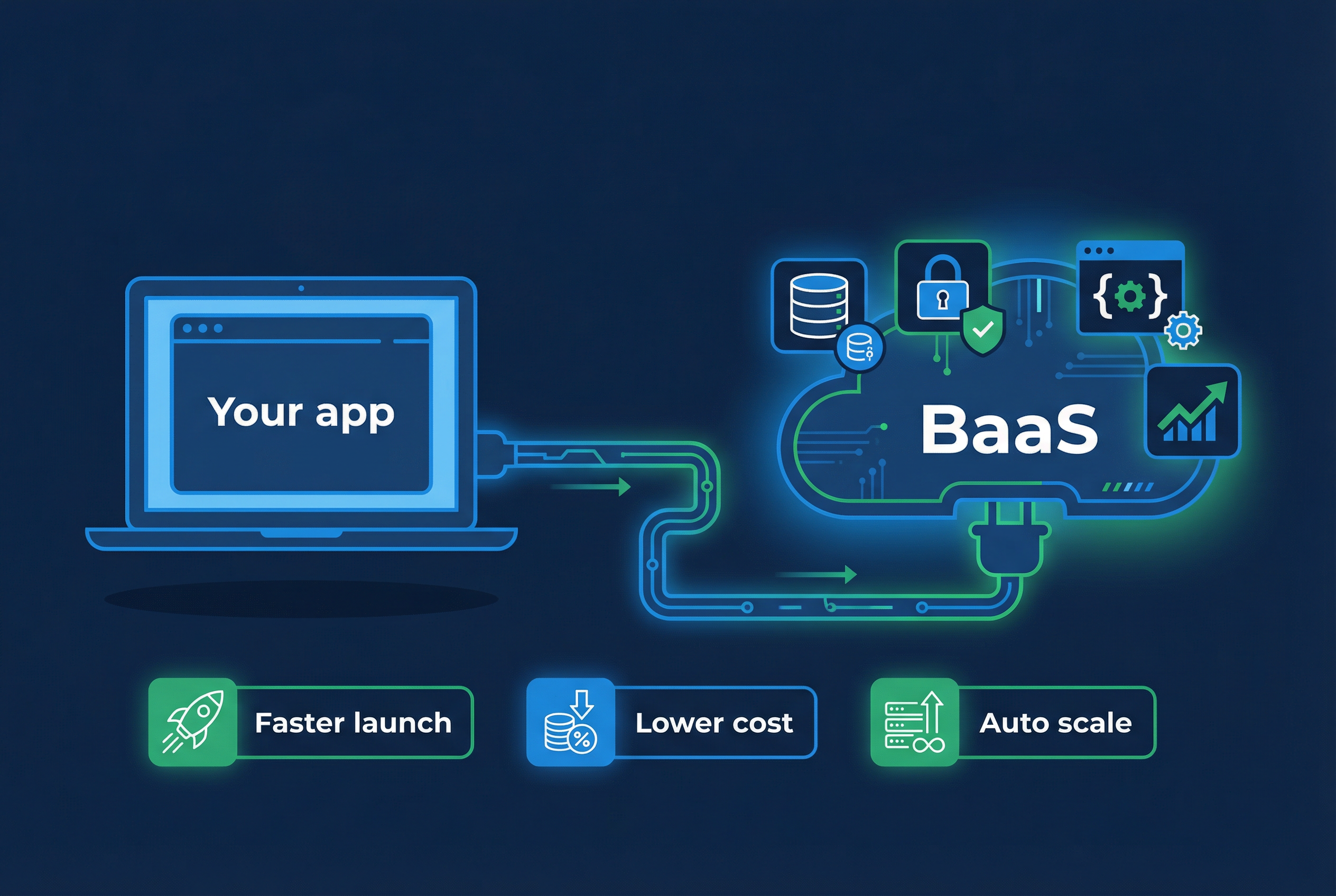

Discover why startups, enterprises, and development teams use a BaaS to ship faster, reduce costs, and scale without managing servers. Explore 21 detailed benefits and compare BaaS vs building your own backend.
Key Takeaways
- A Backend as a Service (BaaS) provides ready-to-use backend components — databases, authentication, APIs, cloud functions — so you can build apps without managing servers.
- The main reasons to use a BaaS: faster development, lower cost, automatic scalability, and the ability to focus on your product instead of infrastructure.
- This article covers 21 detailed benefits of BaaS, grouped into six themes: speed, cost, scalability, quality, delivery, and security.
- Ideal for startups, MVPs, and teams that want to ship faster without building backend from scratch.
- Use the interactive comparison table below to compare BaaS vs custom backend across 24 criteria.
What is a Backend as a Service?
Backend as a Service (BaaS) is a cloud computing model that allows you to outsource the behind-the-scenes aspects of your web or mobile applications. It provides pre-built components for databases, user authentication, API management, cloud functions, file storage, and push notifications — so you can build apps without writing server-side code or managing hardware.
Unlike traditional backend development, which requires manual server setup and middleware configuration, a BaaS uses APIs and SDKs to connect your frontend directly to the cloud. This accelerates your time-to-market and reduces DevOps costs, making it the standard choice for startups and agile teams building modern, scalable applications.
Why Use a Backend as a Service?
BaaS eliminates the complexity of backend development so you can focus on building great products. Here are the four main reasons teams adopt a BaaS.
Ship faster
Launch in days instead of months. Pre-built infrastructure means you start building features immediately — no weeks spent provisioning servers, configuring databases, or setting up authentication.
Control cost
No need to hire backend specialists or maintain server infrastructure. Pay only for what you use and allocate engineers to high-value, product-centric work instead of boilerplate tasks.
Scale without ops burden
Handle traffic spikes automatically. Scale from 100 to 1 million users without changing code, capacity planning, or hiring a DevOps team.
Focus on product
Spend time building features users love, not configuring databases or writing boilerplate code. A BaaS frees your team to focus on UX, business logic, and competitive differentiation.
Watch how a Backend as a Service helps teams ship faster, control cost, and focus on product — without managing servers.
BaaS vs Custom Backend
There is no single “right” choice — the ideal solution depends on the project being developed. Here is a high-level comparison, followed by a detailed, interactive table.
| Aspect | BaaS | Build from Scratch |
|---|---|---|
| Time to Launch | Days/Weeks | Months |
| Upfront Cost | Low (pay-as-you-go) | High (team + infra) |
| Backend Expertise | Minimal | Extensive |
| Scalability | Automatic | Manual configuration |
| Maintenance | Managed | Your responsibility |
| Security Updates | Automatic | Manual |
Detailed Comparison Table
Filter by category, search criteria, and sort to compare Backend as a Service with building and managing your own server.
| Criterion | Backend as a Service | Own Server / Custom |
|---|---|---|
| Initial costcost | Low — subscription or pay-as-you-go plans start from $0–$25/month | High — server hardware or cloud VMs, DevOps tooling, initial setup |
| Ongoing costcost | Predictable monthly subscription; scales with usage tier | Variable — hosting bills, maintenance labor, patching, monitoring tools |
| Cost at scalecost | Can grow with higher-tier plans; some providers offer volume discounts | Potentially lower unit cost at very large scale if you have dedicated DevOps |
| Cost predictabilitycost | Subscription-based plans with clear limits; no surprise bills | Unpredictable — traffic spikes, security incidents, and maintenance add up |
| Setup timespeed | Minutes to hours — sign up, create an app, connect SDK | Days to weeks — provision servers, install dependencies, configure networking |
| Time to marketspeed | Days to weeks for an MVP with pre-built auth, database, APIs | Weeks to months — custom backend code, testing, deployment pipeline |
| Time to first releasespeed | Very fast — focus goes to frontend and business logic from day one | Slow — backend infrastructure must be ready before frontend work is productive |
| Deployment frequencyspeed | Push frontend changes anytime; backend updates are instant or one-click | Requires CI/CD pipeline setup; deployments need testing and rollback plans |
| Server managementoperations | Zero — fully managed by the BaaS provider | Full responsibility — OS updates, patching, security hardening |
| Scalingoperations | Automatic or one-click — provider handles capacity | Manual — capacity planning, load balancers, auto-scaling configuration |
| Monitoring & loggingoperations | Built-in dashboards and alerts provided by the platform | Must set up and maintain monitoring stack (Prometheus, Grafana, etc.) |
| Backupsoperations | Automated backups included; restore with one click | Must configure, schedule, test, and maintain backup procedures |
| Uptime / SLAoperations | May offer SLA; redundant infrastructure | Your responsibility — depends on architecture and resources invested |
| Customizationflexibility | Cloud functions and hooks for custom logic; limited server config | Full control over every layer — OS, runtime, middleware, networking |
| Vendor lock-inflexibility | Depends on provider — open-source BaaS (e.g. Back4App) minimizes lock-in | No vendor lock-in; you own the full stack |
| Multi-cloud / on-premiseflexibility | Some providers (e.g. Back4App) support multi-cloud and self-hosting | Full flexibility to deploy anywhere |
| Team size neededteam | Small — frontend developers can ship a full-stack app | Larger — backend engineers, DevOps, SRE roles required |
| DevOps needteam | None to minimal — provider handles infrastructure | Dedicated DevOps engineer(s) for infrastructure management |
| Expertise requiredteam | Frontend/SDK knowledge sufficient for most use cases | Backend architecture, networking, security, databases, CI/CD |
| Securityrisk | Provider manages patches, encryption, compliance certifications | Your team must handle all security — updates, audits, penetration testing |
| Compliance (GDPR, HIPAA)risk | Leading providers offer SOC 2, HIPAA, GDPR compliance out of the box | Full control but full responsibility — must implement and audit yourself |
| Reliabilityrisk | Redundant, multi-server architecture managed by specialists | Depends entirely on your architecture and ops investment |
| Single point of failurerisk | Offer the option to run redundant infrastructure across availability zones | Risk of single-server setups unless you invest in redundancy |
23 of 23 criteria shown
Key Benefits of a Backend as a Service
These are the main advantages. The full list of 21 benefits follows below.
Development speed
Save up to 80% of backend coding time with pre-built components.
Lower cost
Allocate engineers to high-value work instead of boilerplate infrastructure.
Scalability
Scale from 100 to millions of users without capacity planning.
Security & reliability
Enterprise-grade security, automated backups, and redundant infrastructure.
Focus on product
Spend time building features users love, not configuring servers.
Serverless — zero DevOps
No servers to manage, patch, or monitor.
All Benefits of a Backend as a Service
A comprehensive list of 21 BaaS benefits, grouped by theme. Each benefit explains how a Backend as a Service helps teams build better products faster.
Speed & Time to Market
Development speed
Reduce time to market
React to feedback fast
Cost & Resources
Cost
Fewer software engineers
Focus on high-value code
Scalability & Infrastructure
Scalability
Serverless environment
Outsource cloud infrastructure management
Performance
Reliability
Quality & Focus
Standardize backend development
Focus on core business
Focus on UX and frontend development
AI readiness and GenAI integration
Cross-Platform & Delivery
Cross-platform development
Continuous delivery and integration
Testing and staging environments
Security & Compliance
Security
Privacy requirements
Backup procedures
Frequently Asked Questions
Common questions about why teams use a Backend as a Service and its benefits.
Why use a Backend as a Service instead of building your own backend?
What are the main benefits of a Backend as a Service?
Is a BaaS more expensive than a custom backend?
When should I choose a BaaS over a custom backend?
What are the drawbacks of using a BaaS?
Does a BaaS work for both web and mobile apps?
What is the difference between a BaaS and a custom backend?
Conclusion
The diverse benefits of a Backend as a Service platform underscore its significant role in modern software development.
From accelerating development speed to ensuring cost-effectiveness, scalability, security, and reliability, BaaS presents an attractive solution for startups and established enterprises alike.
Embracing BaaS streamlines the development process and strategically positions businesses for faster adaptation to market feedback — ensuring long-term reliability and success in a dynamic digital landscape.
The right choice between BaaS and a custom backend ultimately depends on your project requirements, team composition, and growth trajectory.
For a full definition of BaaS, how it works, core features, use cases, and how to choose a provider, see our Backend as a Service (BaaS) guide.
Ready to Build with a Backend as a Service?
Start building with Back4App — open-source, predictable pricing, and no vendor lock-in.
Disclosure: This article is published by Back4App, a Backend as a Service provider. The content is intended to explain why teams use BaaS and to outline common benefits; it is based on industry practice and our experience building and operating a BaaS platform. We encourage readers to verify facts and explore providers that fit their own requirements.