Last updated: February 2026
What is a Backend as a Service?
Definition: Backend as a Service (BaaS) is a cloud platform that provides ready-to-use backend components—databases, authentication, APIs, and cloud functions—so you can build apps without managing servers. It's ideal for startups, MVPs, and teams who want to launch faster, reduce costs, and focus on their product instead of infrastructure.

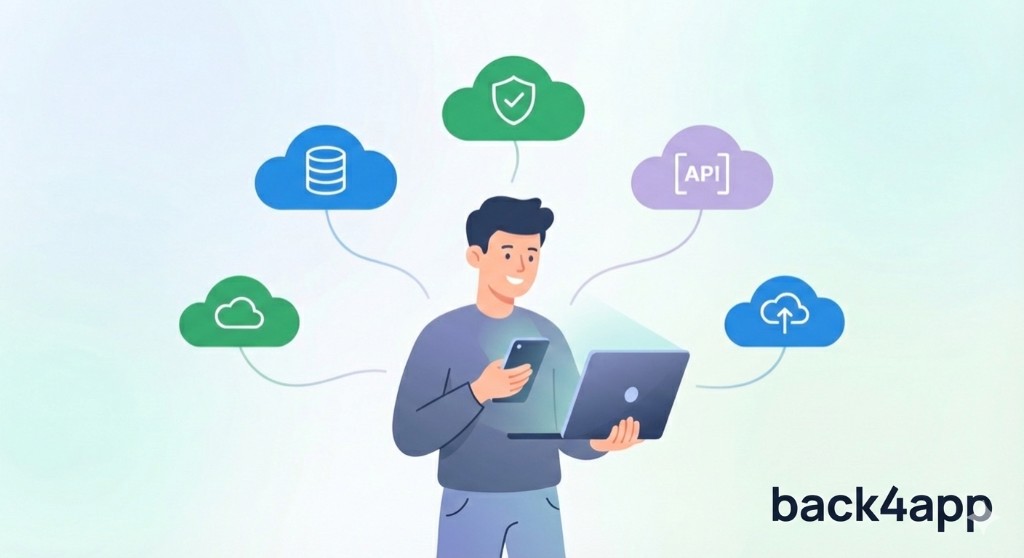
Backend as a Service (BaaS) is a cloud computing model that allows you to outsource the behind-the-scenes aspects of your web or mobile applications.
By providing pre-built components for databases, user authentication, and API management, BaaS enables you to build apps without writing server-side code or managing hardware.
Unlike traditional backend development, which requires manual server setup and middleware configuration, BaaS uses APIs and SDKs to bridge the gap between your frontend and the cloud.
This approach accelerates your time-to-market and reduces DevOps costs, making it the standard choice for startups and agile teams building modern, scalable applications.
How Does a Backend as a Service Work?
BaaS functions as a "plug-and-play" infrastructure layer that connects your frontend to cloud-hosted backend components via standardized APIs and SDKs.
Instead of architecting custom server-side logic, you integrate to managed services—such as databases and user auth—directly into your client-side code.
This eliminates the need for manual server provisioning, allowing you to deploy full-stack functionality with just a few lines of code.
Three steps to go from idea to production using a BaaS
Connect via APIs & SDKs
Use REST APIs, GraphQL, or native SDKs for JavaScript, iOS, Android, Flutter, and more. No backend code required.
Add Custom Logic
Deploy serverless Cloud Functions for custom business logic, webhooks, and third-party integrations without managing servers.
Scale Automatically
Your backend scales with demand. Handle traffic spikes automatically without capacity planning or infrastructure changes.
Core Features of a BaaS Platform
Everything you need to build modern applications, ready out-of-the-box.
Database
NoSQL and relational data with real-time sync, queries, and indexing.
Authentication
OAuth, SSO, MFA, and role-based access control out of the box.
APIs & SDKs
Auto-generated REST & GraphQL APIs with native SDKs for every platform.
Cloud Functions
Serverless JavaScript functions for custom logic and integrations.
File Storage
Store and deliver files globally via CDN with automatic optimization.
Real-time
Live queries and subscriptions for instant data synchronization.
Push Notifications
iOS, Android, and web push notifications with targeting and scheduling.
AI & MCP Integration
Connect AI agents to your backend with Model Context Protocol support.
Why Use a Backend as a Service?
BaaS eliminates the complexity of backend development so you can focus on building great products.
Watch: Why should you use a Backend as a Service?
Faster Time-to-Market
Launch in days instead of months. Pre-built infrastructure means you start building features immediately.
Reduced Development Costs
No need to hire backend specialists or maintain server infrastructure. Pay only for what you use.
Built-in Security
Enterprise-grade security with SOC 2, HIPAA compliance, encryption, and role-based access control.
Automatic Scalability
Handle traffic spikes automatically. Scale from 100 to 1 million users without changing code.
Zero DevOps
No servers to manage, patch, or monitor. Focus on your product while we handle infrastructure.
Focus on Product
Spend time building features users love, not configuring databases or writing boilerplate code.
Read the article Why Use a Backend as a Service to learn how to slash development time, reduce costs, and focus entirely on your product.
Common BaaS Use Cases
Backend as a Service is ideal for a wide range of applications.
SaaS Applications
Build multi-tenant SaaS platforms with user management, subscriptions, and data isolation.
Mobile Apps
Power iOS, Android, and cross-platform apps with real-time sync, push notifications, and offline support.
MVPs & Prototypes
Launch quickly to validate ideas without investing months in backend development.
Internal Tools
Create admin panels, dashboards, and workflow tools with secure authentication.
E-Commerce
Build shopping carts, order management, and payment integrations with robust databases.
Real-time Apps
Create chat apps, live collaboration tools, and multiplayer games with instant data sync.
BaaS vs. Building from Scratch
See how using a Backend as a Service compares to traditional backend development.
| Aspect | BaaS | Build from Scratch |
|---|---|---|
| Time to Launch | Days/Weeks | Months |
| Upfront Cost | Low (pay-as-you-go) | High (team + infra) |
| Backend Expertise | Minimal | Extensive |
| Scalability | Automatic | Manual configuration |
| Maintenance | Managed | Your responsibility |
| Security Updates | Automatic | Manual |
BaaS vs. PaaS vs. IaaS
Understand how Backend as a Service compares to other cloud computing models.
| Managed by Provider | BaaS | PaaS | IaaS |
|---|---|---|---|
| Infrastructure (Servers, Network) | |||
| Runtime & OS | |||
| Scaling | |||
| Database | |||
| Authentication | |||
| APIs (REST/GraphQL) | |||
| File Storage | |||
| Push Notifications |
BaaS Examples
Back4app, Firebase, Supabase
PaaS Examples
Heroku, Railway, Render
IaaS Examples
AWS EC2, GCP Compute, Azure VMs
Decision Matrix: BaaS or Custom Backend?
Use this framework to determine if BaaS is the right choice for your project.
Use BaaS When...
- You need to launch quickly (MVP, prototype, hackathon)
- Your team lacks backend expertise or DevOps resources
- Standard features (auth, CRUD, storage) cover most core requirements
- Budget is limited and you need predictable costs
- Scaling requirements are unpredictable
Build Custom When...
- You need proprietary algorithms or complex data processing
- Full infrastructure control is a regulatory requirement
- You have dedicated DevOps resources and want to manage infrastructure
- At massive scale, cost optimization is critical
- Your backend IS the product (infrastructure company)
Limitations & Trade-offs
Understanding these considerations will help you decide if BaaS is right for your project.
Vendor Lock-in
Proprietary platforms can make migration difficult. Choose open-source solutions like Back4app for data portability.
Cost at Scale
Pay-as-you-go pricing can become expensive at very high volumes. Self-managed infrastructure may offer savings at extreme scale.
Customization Limits
Less control over server configs and database tuning. Complex proprietary algorithms may require a custom backend.
Reduced Visibility
Debugging can be harder without full stack control. Look for providers with robust logging and monitoring tools.
Infrastructure Control
If you need full control over networking, bare-metal performance, or specific server configurations, consider self-hosting.
Compliance Requirements
Some regulations may require on-premise hosting. Verify your BaaS provider meets your specific compliance needs.
How to Choose a BaaS Provider?
Evaluate providers based on these key criteria to find the right fit for your project.
Open-Source vs. Proprietary
Open-source platforms like Back4app offer more flexibility and avoid vendor lock-in.
Pricing Model
Compare predictable pricing vs. pay-as-you-go. Watch for hidden costs on bandwidth and storage.
Data Ownership & Portability
Can you export your data easily? Can you self-host if needed?
Compliance (SOC 2, HIPAA, GDPR)
Ensure the provider meets your security and regulatory requirements.
Vendor Lock-in Risk
Evaluate how difficult it would be to migrate away if needed.
Community & Documentation
Strong documentation and active community support accelerate development.
Top Backend as a Service Providers (2026)
Compare the leading BaaS platforms to find the best fit for your project.
Back4app
Best for AI-Native Development & Scalable Open-Source Architecture
Firebase
Best for Google Ecosystem & Mobile Analytics
Supabase
Best for SQL Power Users & Real-time Postgres
Appwrite
Best for Privacy-Conscious Teams & MariaDB Performance
AWS Amplify
Best for Rapid Deployment within the AWS Stack
See how these providers compare across key features
| Feature | Back4appRecommended | Firebase | Supabase | Appwrite | AWS Amplify |
|---|---|---|---|---|---|
| Open Source | |||||
| Database | MongoDB | Firestore | PostgreSQL | MariaDB | DynamoDB |
| Free Tier | |||||
| Real-time | |||||
| AI/MCP Ready | |||||
| Container Deployment | |||||
| AI Frontend Coding |
Every platform listed here is a leader in the BaaS space. The decision to use one over the other is subjective and will depend on your specific use case, budget constraints, and the personal preferences of your engineering team.
Frequently Asked Questions
Common questions about Backend as a Service platforms.
What is a Backend as a Service (BaaS)?
What is the difference between BaaS and PaaS?
Is Firebase a Backend as a Service?
What are examples of Backend as a Service?
How much does a Backend as a Service cost?
Is BaaS suitable for enterprise applications?
Can I migrate away from a BaaS provider?
What is the difference between BaaS and serverless?
Is BaaS good for AI apps?
Ready to Build Your Backend?
Start your project in minutes. No credit card required.