Last updated: February 2026
The 10 Best Firebase Alternatives in 2026
Open-source, self-hosted, and more affordable backend platforms — compared and ranked. Find the right backend for your web, mobile, or AI application without vendor lock-in.
Key Takeaways
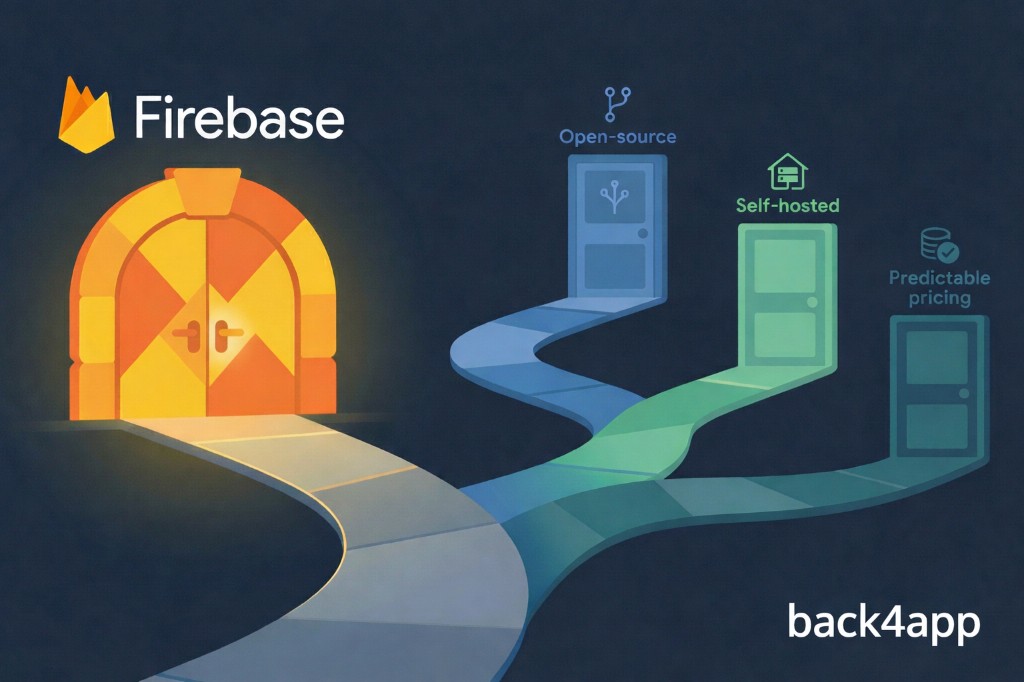
Firebase alternatives are backend-as-a-service (BaaS) platforms that offer similar capabilities to Google Firebase—databases, authentication, real-time sync—often with open-source code, self-hosting, or more predictable pricing.
- Firebase alternatives address vendor lock-in, unpredictable costs, and GCP-only hosting limitations.
- The top open-source alternatives are Back4App, Supabase, and Appwrite.
- Modern platforms now combine AI integration, GraphQL APIs, real-time data, and multi-cloud deployment.
- All 10 platforms offer a free tier, 9 support self-hosting, and 7 are fully open-source — something Firebase does not offer.
What is Firebase?
Firebase is Google's cloud-based app development platform, offering a suite of tools to build, deploy, and scale mobile and web applications. It includes NoSQL databases (Cloud Firestore and Realtime Database), real-time data synchronization, user authentication, file storage, hosting, analytics, and cloud functions.
In 2026, Firebase has added Firebase Studio (an AI-driven development environment), Firebase Data Connect (managed PostgreSQL with GraphQL), and expanded AI capabilities through the Genkit framework and Gemini integration.
Despite these advances, many development teams are evaluating alternatives due to key limitations around vendor lock-in, pricing unpredictability, and hosting restrictions — challenges that become more significant as applications scale.
Why Look for Firebase Alternatives?
While Firebase remains a powerful platform, several recurring concerns drive developers toward alternatives. These are the most common pain points cited in community forums, developer reviews, and industry discussions.
Vendor Lock-in & Closed Source
Firebase is proprietary and tightly coupled to Google's ecosystem. Migrating data and logic to another backend often requires significant re-engineering. With no access to the source code, customization is limited to what Google exposes through its APIs.
Unpredictable Pricing at Scale
Firebase's pay-as-you-go model charges per database read/write, storage, and bandwidth. High-traffic applications can face surprising bills — one developer reported a usual $50/month bill jumping to $70,000 in a single day. There is no built-in budget cap.
Limited to Google Cloud Hosting
Firebase runs exclusively on Google Cloud Platform. Developers who need multi-cloud, hybrid, or on-premise deployment for data residency requirements or compliance cannot use Firebase without additional workarounds.
NoSQL Constraints
Firestore's document-based NoSQL model works for simple data structures but becomes limiting for complex relational queries, aggregations, and data migrations. Teams that need SQL capabilities often struggle with Firestore's querying limitations.
Data Sovereignty & Compliance
Data stored in Firebase lives on Google's servers. Meeting strict HIPAA or regional data-residency regulations can be challenging, since Firebase does not natively support self-hosted or on-premise deployments.
What Developers Are Saying
Real feedback from developer communities about Firebase and its alternatives.
“Firebase bill is usually $50, but I was surprised to see a $70k bill in one day.”

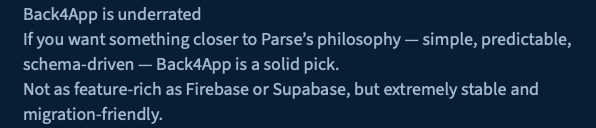
“Much, much easier to set up for CRUD — I can get one up within half an hour. Documentation is excellent, far better than Firebase. And the data belongs to you.”
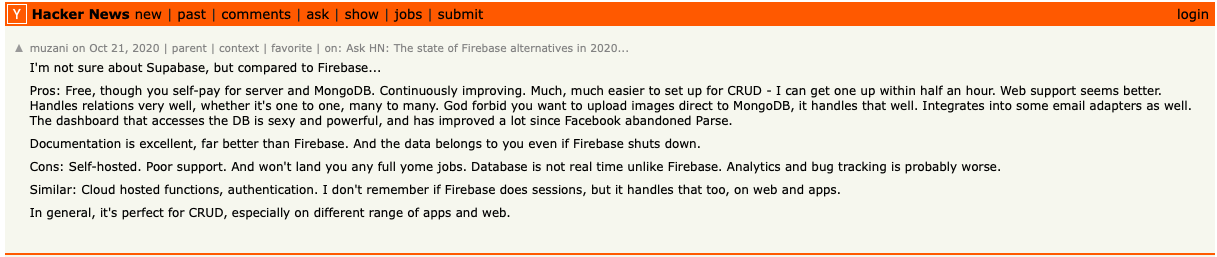
“Back4App is underrated. Not as feature-rich as Firebase or Supabase, but extremely stable and migration-friendly.”
“Supabase has been better in every way than Firebase. Even if it wasn't open source, I'd still prefer it.”

How These Alternatives Were Evaluated
Each platform was assessed based on publicly available documentation, pricing pages, and developer community feedback. The following criteria were used:
Open-Source Availability
Source code access and self-hosting capability
Database Type
SQL, NoSQL, or hybrid data model support
API Model
REST, GraphQL, and real-time subscription support
Pricing Transparency
Free tiers, predictable plans, and cost at scale
Deployment Flexibility
Cloud, self-hosted, multi-cloud, and on-premise options
AI & Modern Tooling
MCP support, IDE integration, and AI-ready workflows
The 10 Best Firebase Alternatives
Each platform is evaluated with features, pricing, pros, and best-fit use cases. Click any card to expand the full breakdown.
Back4App
Open SourceOpen-source backend with predictable pricing, auto-generated APIs, and multi-cloud deployment.
Supabase
Open SourceOpen-source PostgreSQL platform often called "the open-source Firebase alternative."
Appwrite
Open SourceSelf-hosted open-source backend with Docker deployment and multi-language SDK support.
AWS Amplify
Enterprise-grade full-stack platform deeply integrated with Amazon Web Services.
Backendless
Visual low-code platform combining a UI builder, codeless logic, and powerful BaaS backend.
PocketBase
Open SourceUltra-lightweight single-binary Go backend with embedded SQLite — perfect for MVPs and side projects.
Nhost
Open SourceGraphQL-first open-source backend powered by PostgreSQL and Hasura for instant APIs.
Kuzzle
Open SourceModular open-source backend platform designed for IoT, real-time, and connected applications.
Hasura
Open SourceHigh-performance GraphQL engine that generates instant APIs over any database.
Xano
Visual backend builder with PostgreSQL, AI-ready workflows, and no-code API generation.
Firebase Alternatives Comparison Table
Filter and sort to find the backend platform that matches your requirements.
| Platform | Open Source | Primary Database | Free Tier | Pricing From | Self-Hosted | MCP | AI Agent | Push Notifications | Geo Queries | Offline Support |
|---|---|---|---|---|---|---|---|---|---|---|
| Back4App★ | MongoDB | $15/mo | Native | |||||||
| Supabase | PostgreSQL | $25/mo | Plugin | |||||||
| Appwrite | MariaDB | $25/mo | Native | |||||||
| AWS Amplify | DynamoDB | Pay-as-you-go | Native | |||||||
| Backendless | Hybrid (SQL/NoSQL) | $15/mo | ||||||||
| PocketBase | SQLite | Free | ||||||||
| Nhost | PostgreSQL | $25/mo | Plugin | |||||||
| Kuzzle | Elasticsearch | Custom | Native | |||||||
| Hasura | Multi-DB | Pay-as-you-go | ||||||||
| Xano | PostgreSQL | $85/mo |
10 of 10 platforms shown
Firebase Alternatives Compared
Watch a quick comparison of the top Firebase alternatives and how they stack up.
Which Firebase Alternative Is Right for You?
Answer 4 quick questions to get a personalized recommendation.
Question 1 of 4
What type of database do you prefer?
How to Migrate from Firebase
Migrating away from Firebase requires careful planning, but most modern alternatives provide tools and documentation to simplify the process. Here is a general migration approach:
Export Your Data
Export Firestore or Realtime Database data as JSON. Use Firebase's built-in export tools or the Admin SDK to extract collections and documents.
Map Your Schema
Translate your Firebase data model to the new platform's format. For SQL-based alternatives (Supabase, Nhost), convert document structures into relational tables.
Migrate Authentication
Export user records including email, hashed passwords, and OAuth provider data. Most alternatives support importing Firebase Auth users.
Update Client SDKs
Replace Firebase SDK calls with the new platform's SDK. This is usually the most time-intensive step — start with a single feature and expand.
Test in Staging
Run the migrated backend in a staging environment. Verify data integrity, authentication flows, real-time features, and edge cases before switching production traffic.
Back4App migration support: Back4App provides migration documentation and tooling to help teams transition from Firebase, including data import utilities and SDK migration guides.
Frequently Asked Questions
Common questions about Firebase alternatives, migration, and choosing the right backend platform.
What are the best alternatives to Firebase?
Is there a free alternative to Firebase?
Is there an open-source version of Firebase?
Which Firebase alternative is cheaper than Firebase?
Can I self-host a Firebase alternative?
How do I migrate from Firebase to another platform?
Which Firebase alternative has the best real-time features?
What is the difference between Firebase and Back4App?
Ready to Move Beyond Firebase?
Start building with Back4App — open-source, predictable pricing, and no vendor lock-in.
Disclosure: This guide is published by Back4App, one of the platforms featured in this comparison. All platforms listed are established leaders in the Backend-as-a-Service space, and there is no single “best” option — the right choice is ultimately subjective and depends on your project requirements, budget, and the technical preferences of your team. Although we made every effort to ensure accuracy using publicly available documentation and pricing, details may have changed since publication or may not be fully accurate. We recommend verifying information on each vendor's official website before making a final decision.